
Bùi Hữu Hùng
Vietnamese lacquer master, b. 1957, Hà Nội.
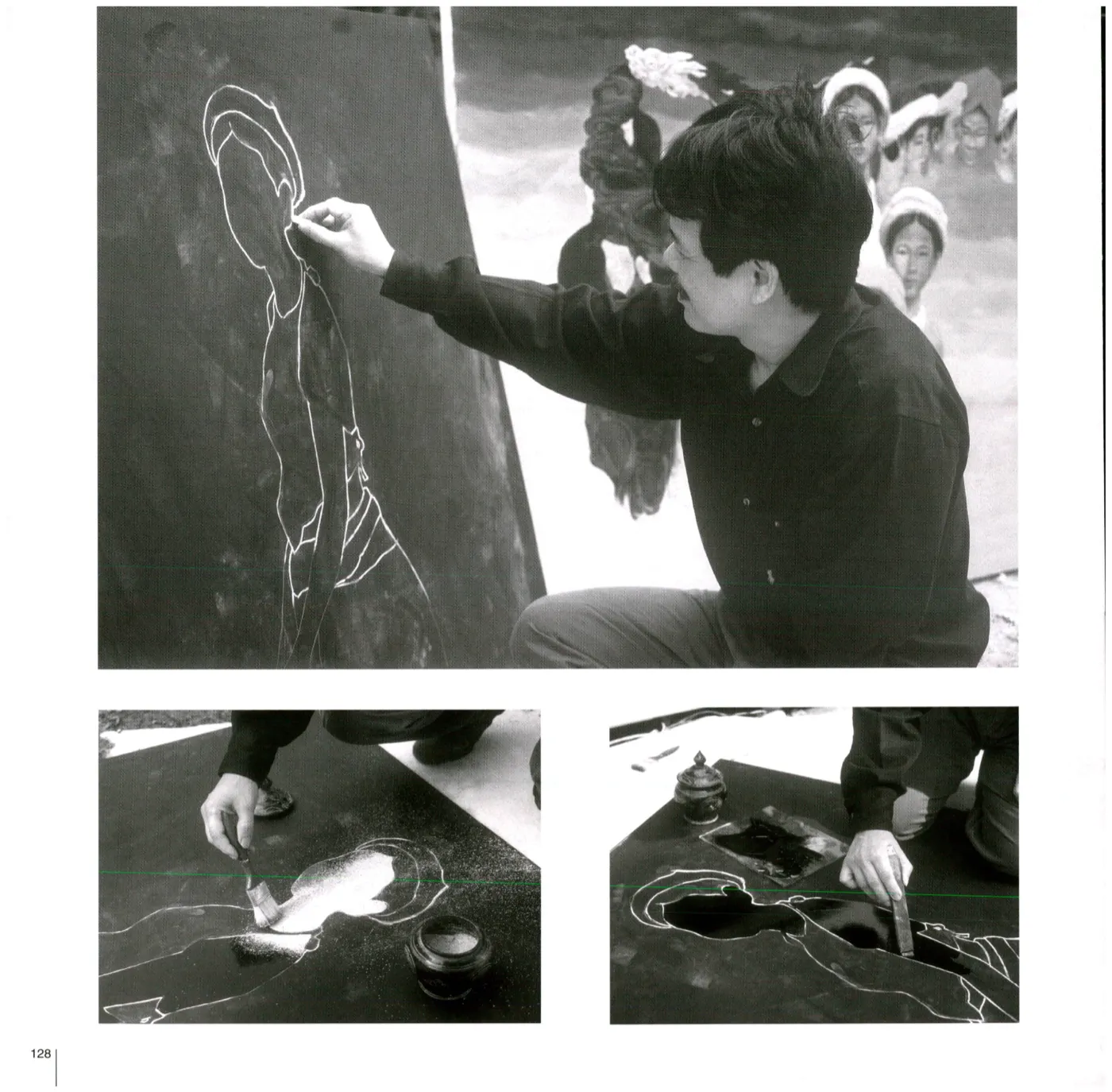
Bùi Hữu Hùng was born in Hanoi in 1957. His introduction to lacquer came at eighteen, when he traveled through villages in northern Vietnam to study sơn mài techniques with the artisans who still practiced them — a generation of craftspeople for whom the medium had not yet fully made the transition from finish to painting. After military service in 1978, he trained at the Vietnam University of Fine Arts, the institutional successor to the École des Beaux-Arts de l'Indochine where, half a century earlier, Vietnamese students and French teachers had together transformed lacquer from a craft into a modern painting medium.
In 1986, Hùng founded his studio in the Tây Hồ district of Hanoi, where he has worked since. He has been a member of the Vietnam Association of Visual Arts since 1986 and the International Lacquer Artists Association since 1996. The Bùi Hữu Hùng Foundation, established in 2023, is the principal authority on his archive and the primary institutional steward of his body of work.
Hùng's work centers on a recurring set of subjects: courtly women in elaborate Nguyễn-dynasty garments, mandarins in stillness, ritual interiors, fields of cinnabar marked with seal-script characters. The figures are not historical portraits. They are composites — apparitions of an imagined imperial past, rendered with a deliberateness that resists both folk-art simplification and historical-painting illustration. Their faces are calm, often downcast or in three-quarter view. Their costumes are built of gold leaf, crushed eggshell, and the layered chemistry of natural lacquer. Around them, the surface of the panel is treated as atmosphere rather than place — saffron fields, deep emerald grounds, a warm black that reads as light.
His central conceptual framework — sometimes described as Royal Nostalgia — does not romanticize the colonial period. It looks past that century, into the older Vietnamese imagination of ritual, sovereignty, and elegance. The medium itself does this work. Lacquer carries a depth that is built into the panel rather than represented on it; layered, sanded back, polished over weeks. Hùng treats the past not as image but as material.
He has exhibited internationally since the 1990s, with shows in Hanoi, Singapore, Hong Kong, London, New York, Norway, Bulgaria, Poland, and Belgium. His work has been transacted at Christie's, Bonhams, and other international auction houses, and is held in private collections across Asia, Europe, and North America.
In 2000, the Vietnam Nostalgia monograph was published in collaboration with the artist, documenting forty-eight large-format lacquer works produced during a particularly sustained period of his practice. The works documented in that volume comprise the present collection, here presented for the first time as a single coherent body. Each is accompanied by Hùng's signed Certificate of Authenticity.
He continues to work in his Tây Hồ studio.
Selected exhibitions
- 1995Vasava Studio · Poland — TK
- 1996Hồng Kong Lacquer Painting · TK
- 1998Art House Gallery · London — TK
- 1999"A Novel Traditional" · Apricot Gallery, Hanoi — TK
- 2000Motcomb Gallery · London — TK
- 2001"Rumination" · Sofitel Métropole, Hanoi — TK
- 2002"Recollection of the Past" · Apricot Gallery, Ho Chi Minh City — TK
Exhibitions list to be verified against research-synthesis.md and the artist's archive.