
The Lacquer Inheritance
A short history of Vietnamese sơn mài, from village workshop to modern painting.
Sơn mài occupies a singular place in modern painting. There is no exact equivalent in any other tradition. Built in many layers over weeks or months, then sanded back to reveal what was deliberately hidden, it is a way of making an image that does not sit on a surface but becomes one. The image you see in a finished work is the visible outcome of many decisions the viewer cannot see — and that, in part, is the point.
To understand the contemporary lacquer paintings of Bùi Hữu Hùng, it helps to begin not with him, but with the material he chose to inherit.
§ IA long material tradition
Lacquer has been used in Vietnam for more than two thousand years. The sap of Toxicodendron succedaneum, harvested and processed by villages in the northern provinces, was used to seal temple beams, finish palace doors, protect ritual implements, and waterproof the surfaces of daily life. By the time of the Lý dynasty in the eleventh century, lacquered objects had become a sustained part of Vietnamese material culture — practical, religious, and decorative in equal measure.
What changed in the twentieth century was not the material but the question asked of it. For most of its history, lacquer in Vietnam was understood as a craft: a way of finishing surfaces, not of making images on them. The transition from finish to painting — from coating to canvas — happened slowly, then suddenly, in the space of a single generation.
§ IIThe École des Beaux-Arts de l'Indochine
In 1925, the French colonial administration founded the École des Beaux-Arts de l'Indochine (EBAI) in Hanoi, under the directorship of the painter Victor Tardieu and the painter-pedagogue Joseph Inguimberty. The school's curriculum was modelled on the academic program of the École des Beaux-Arts in Paris — perspective, anatomy, modelling, classical composition — but its students were Vietnamese, and the materials and motifs they brought with them were not.
It was Inguimberty, already living in Hanoi, who recognised that the lacquer being used on furniture and architectural fittings around the school was a medium of unrealised pictorial possibility. In 1927, a lacquer studio was added to the school's program. Vietnamese students — including Trần Văn Cẩn, Trần Quang Trân, and others — began experimenting alongside the artisan Đinh Văn Thành, who had grown up in a lacquer-producing village. What they made together was something new: not French painting on a Vietnamese ground, and not traditional craft elevated by signature, but a modern painting medium native to Vietnam.
The result is sometimes called Indochinese Modernism — a phrase that should not be heard as either nostalgia or apology. The institutional frame was colonial; the material intelligence was not. French pedagogy supplied the formal language of perspective and composition; Vietnamese artists, artisans, and the lacquer itself supplied the depth, the patience, and the conceptual structure. The medium was not handed down; it was made.
The technique
To understand a sơn mài painting, look at the cracks that aren't there.
The work begins with a vóc — a wooden panel of seasoned ironwood or layered plywood, sealed with raw lacquer and dried until the surface is hard, dark, and slightly glossy. The artist draws the composition lightly, often with chalk. Then the building begins.
Layer is applied over layer. Mineral pigments are mixed into the lacquer for color. Crushed eggshell — usually duck — is embedded directly into the surface to produce whites and creams, because pure white pigment does not behave well in the chemistry of natural lacquer. Silver and gold leaf are placed and adhered, sometimes covering large fields, sometimes used only for selected forms or atmospheric effects. Each layer must dry — slowly, in the high humidity of a Vietnamese summer or a controlled studio — before the next is applied. A single panel may carry ten, fifteen, sometimes twenty layers, accumulated over weeks.
Then the artist takes a stone, a piece of charcoal, or fine sandpaper, and grinds back into the surface.
This is the part that gives the medium its character. The sanding is not a finishing pass; it is the painting itself. As the upper strata are abraded away, lower layers re-emerge — layers placed there days or weeks earlier, sometimes with a specific reveal in mind, sometimes not. A field of black opens to reveal the silver foil beneath; a stroke of cinnabar gives way to gold; the eggshell's white edge sharpens against the lacquer's depth. The image is not painted onto the panel. It is discovered in the panel — the visible outcome of decisions buried deep enough that the artist himself cannot fully predict what the surface will yield.
The medium is, in this sense, both additive and subtractive at the same time. It is built up, then revealed.
A finished sơn mài work is then polished — sometimes for many hours — until the surface acquires the matte-but-luminous depth that has become the medium's signature. The image appears to glow from within. It does not, strictly. What it has is layers — and the mind, looking at it, perceives that depth as light.
The first generation
The painters trained at EBAI in the 1930s and 1940s established what is now treated as the first generation of modern Vietnamese lacquer.
Nguyễn Gia Trí (1908–1993) is the canonical figure. Working on multi-panel screens of an ambition that European decorative tradition could not have anticipated — fields of women in red landscapes, mythological scenes, allegorical compositions — Nguyễn Gia Trí treated lacquer as a medium fully equal to oil paint, and produced works that the international market has, in the last decade, acknowledged with eight-figure prices. Phạm Hậu (1903–1995) developed a different language, more decorative, more architectural in its rhythm; his lacquer screens of carp and seasonal motifs have crossed the million-dollar mark at Sotheby's. Trần Quang Trân, Nguyễn Khang, Trần Văn Cẩn, and others built the technical and pictorial vocabulary that subsequent generations inherited.
The painters of the second generation worked through the most disruptive decades of Vietnamese history — partition, war, postwar reconstruction. Their lacquer often turned more political, more public, more explicitly engaged with national experience. Nguyễn Sáng, Nguyễn Tư Nghiêm, and others extended the medium without breaking with it.
What followed — the third generation — inherited a body of work to which they could neither simply add nor wholly depart from. They had to find a way to make sơn mài contemporary without losing what made it sơn mài.
§ VBùi Hữu Hùng and the third generation
Bùi Hữu Hùng, born in Hanoi in 1957, is among the artists most often identified with that third generation. His fascination with lacquer began at eighteen, when he traveled through the northern villages to study traditional techniques with the artisans who still practiced them. He served in the army in 1978. He trained at the Vietnam University of Fine Arts — the institutional successor to EBAI — and continued his lacquer practice through the period of Đổi Mới, the late-1980s economic and cultural opening that allowed Vietnamese artists, for the first time in decades, to work for an international audience.
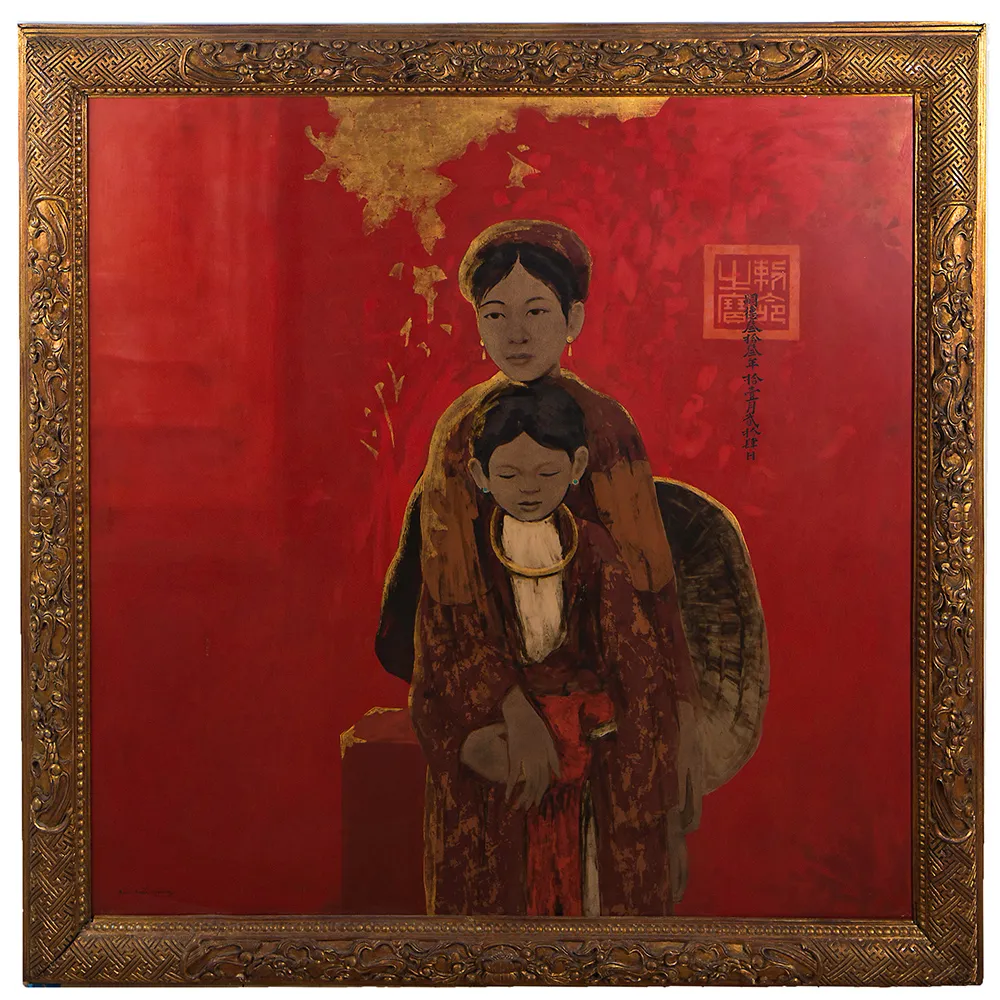
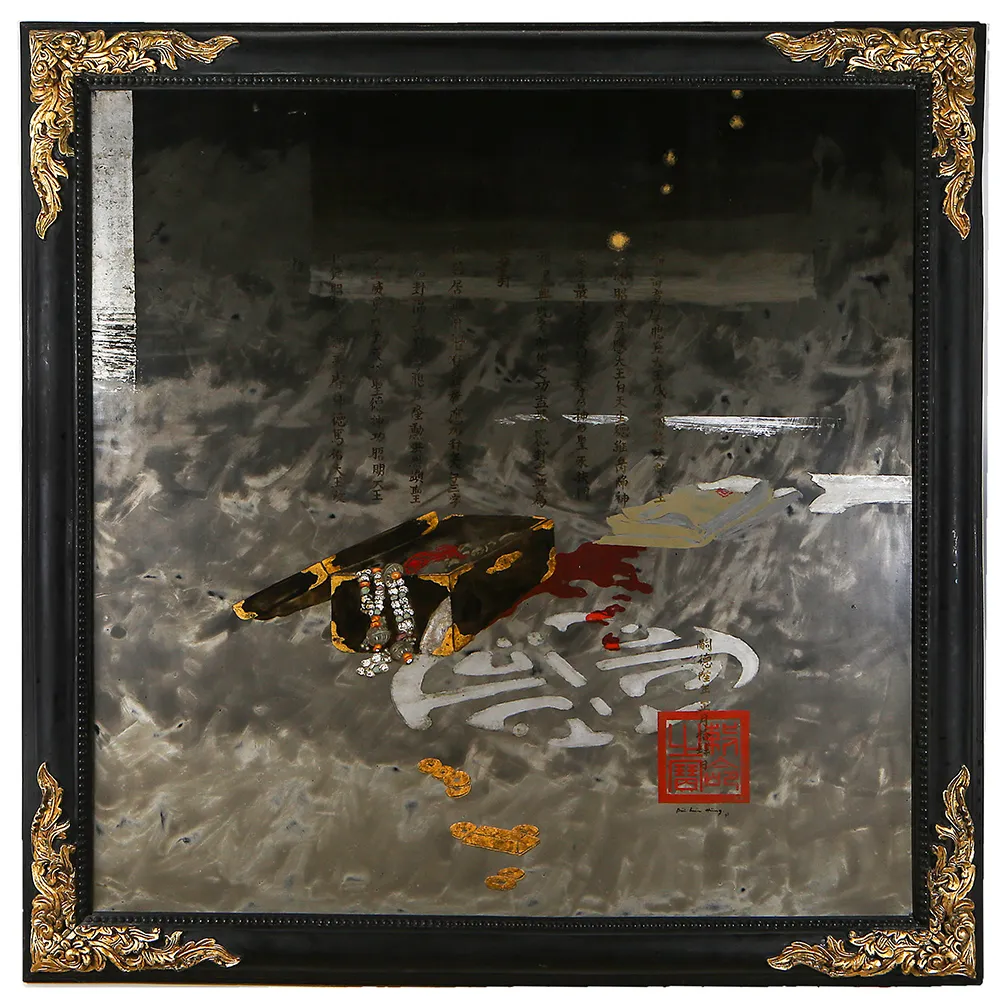
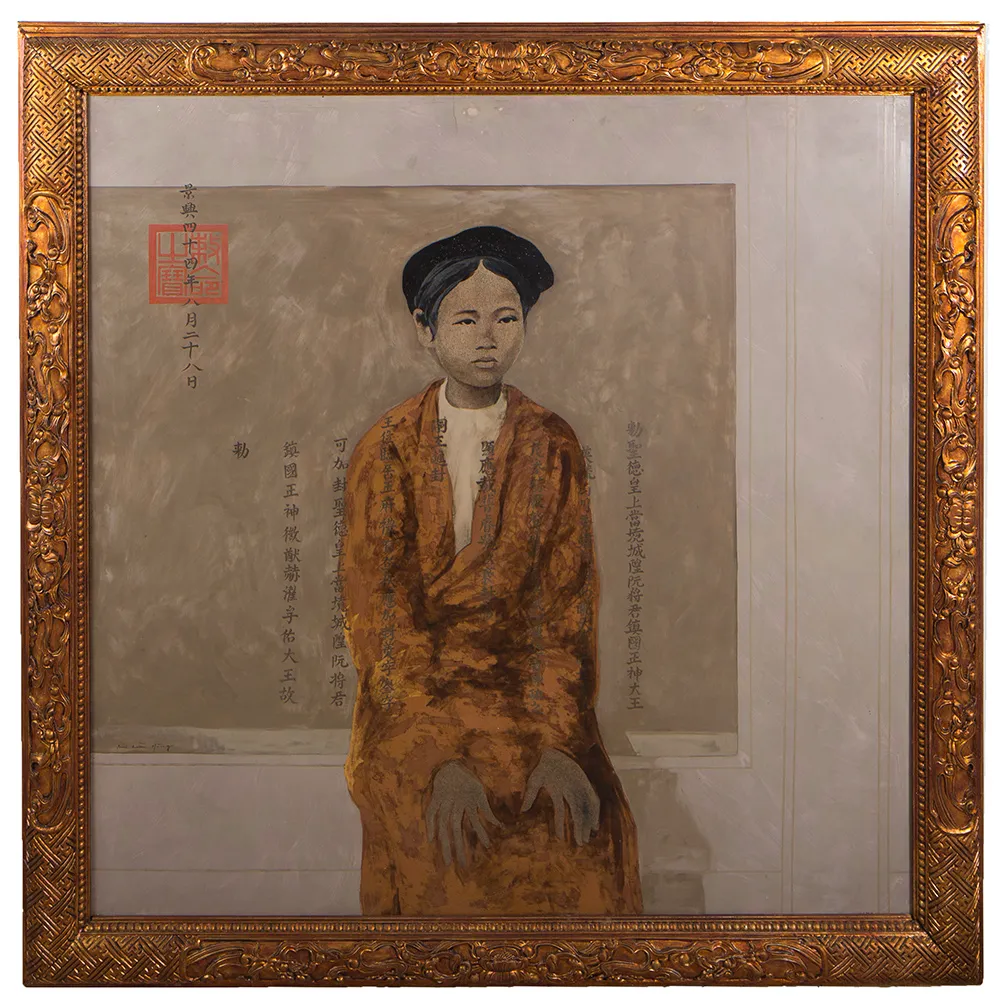
What Hùng made of the medium is a body of work organized around a recurring set of subjects: courtly women in elaborate garments, mandarins, ritual interiors, theatrical stillness, the imagined or remembered atmosphere of Vietnamese imperial life. His figures are dressed in the long áo dài of the Nguyễn dynasty, sometimes overlaid with text from classical Vietnamese poetry, sometimes set against fields of pure cinnabar marked with seal-script characters that read as both signature and incantation.
The figures are not portraits in the European sense. They are not likenesses of identifiable people. They are something closer to apparitions — composites of dynastic memory, imagined ancestresses, the kinds of figures one might see at the edge of a long historical dream. Their faces are calm, sometimes downcast, occasionally direct. Their hands are still. The space around them is more atmosphere than place — fields of saffron, deep emerald, a black so warm it reads as living.
This subject — the imagined courtly past of pre-modern Vietnam, rendered in a medium that itself is a survival of pre-modern Vietnamese craft — has earned Hùng's body of work a particular framing in the Asian-art market. It is sometimes called Royal Nostalgia: a contemporary practice that is not interested in nostalgia for the colonial period (which would be politically incoherent) and not interested in folk craft (which would be reductive), but in the older, deeper memory of Vietnamese self-rule, ritual, and elegance. The country before the long century of disruption.
That is a difficult subject to handle without sentimentality. Hùng's discipline is that he handles it materially. The figures float in fields of layered lacquer, their costumes built of gold leaf and crushed eggshell, the seal-script characters around them embedded into the panel rather than written across it. The past, in his work, is built up and then sanded back into. It is not a representation. It is a surface — and the surface remembers.
Why this body of work
Hùng's market sits one full tier below the canonical EBAI masters. A first-generation Nguyễn Gia Trí lacquer screen now reaches into the seven and eight figures at international auction. Hùng's works at major auction houses have, over the past decade, ranged from the low thousands to the mid five figures, with rising trajectory. He is recognized; he is not yet at the price level his medium and lineage might eventually argue for.
This is, for collectors who care about Vietnamese modernism, the moment in which serious examples of the third generation can still be acquired at prices that allow a private collection to be assembled. The international institutional recognition of Vietnamese sơn mài — through the National Gallery Singapore's curatorial work, through Asian-art programming at major museums, through the rising prominence of Vietnamese artists in Hong Kong, Singapore, and Paris auction calendars — has begun to compress the gap between historical recognition and market recognition. It will continue to compress.
To collect a Hùng lacquer painting is to take into one's care an object that resists shortcuts. The medium does not allow them. Neither does the body of work. What is rewarded — over years of looking — is the same patience the artist gave the panel.